
Art Before Architecture: The Ideas at Art Basel Qatar That Interior Design Should Be Paying Attention To
The people who attended Art Basel Qatar 2026 as an art fair missed the point.
The fair ran from 3 to 7 February at Msheireb Downtown Doha, and yes, there were 84 artist presentations, 87 galleries from 31 countries, and serious sales activity across every tier of the market. But for anyone designing interiors in this region — particularly for the palaces, private residences, and hospitality projects that define work at this level — the more important reading was spatial. What scale were the commissions working at? How were structures suspended? What kinds of voids were being created, and what would it take to build architecture around them?
These are not aesthetic questions. They are procurement briefings in disguise.
WHAT “BECOMING” ACTUALLY MEANS
The fair’s curatorial director, Egyptian-born artist Wael Shawky, organised the entire programme around a single theme: Becoming. In art-world terms, this signals work in flux — identities forming, structures shifting, objects that resist fixed definition. In design terms, it translates directly into a spatial challenge: how do you design an interior for a client whose acquisition strategy is still evolving?
For serious residential clients in this region — many of them collectors who move between Doha, London, and Geneva — this is not a theoretical question. The acquisition happens first. The architecture has to catch up. The only way to design ahead of that curve is to be in the room when the acquisitions are being made.
THE INSTALLATIONS THAT MATTER
Art Basel Qatar’s Special Projects programme was its most significant offering. Nine site-specific works were commissioned across Msheireb Downtown Doha — the largest group of new commissions ever presented at an Art Basel fair, with six installed outdoors and three indoors. The scale and ambition of these projects set the terms of what collectors in this market will want to display, commission, and eventually live alongside.
Rayyane Tabet’s What Dreams May Come transformed a heritage courtyard into a palm frond pavilion. What reads as poetic on a press release is, in practice, a structural and material specification. Tabet’s work used the courtyard’s existing proportions and the load-bearing logic of frond architecture — lightweight, canopied, porous to light — to create an interior-within-exterior. For anyone designing a majlis, a villa courtyard, or a double-height residential entrance in Qatar or the UAE, this is the kind of spatial compression and release that now constitutes a client brief. The vocabulary is different. The demand is identical.
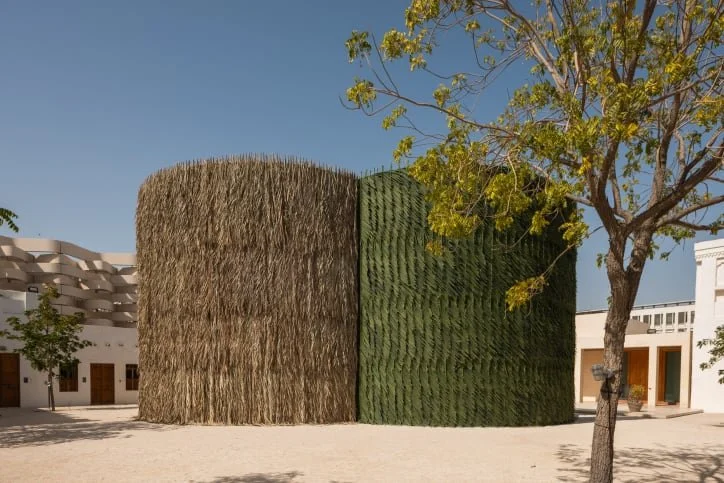
Art Basel / Courtesy the artist and Sfeir-Semler Gallery
Sumayya Vally’s Assembly of Lovers operated on a different axis entirely. The South African architect-artist’s shape-shifting installation treated assembled components as a collective body — parts that read as fractured at close range, whole when viewed from distance. The design implication is one of structural suspension and volume management: works at this scale require clear sightlines, controlled ceiling heights, and floor surfaces that recede rather than compete. You cannot retrofit architecture around a Sumayya Vally commission. You build the architecture first, with specific ceiling clearances and approach sequences designed around the piece, before it arrives.
If you aren’t tracking scale and structural suspension at events like this, you cannot design the architecture to hold what your client will commission next. That is not a design principle. It is an operational fact.
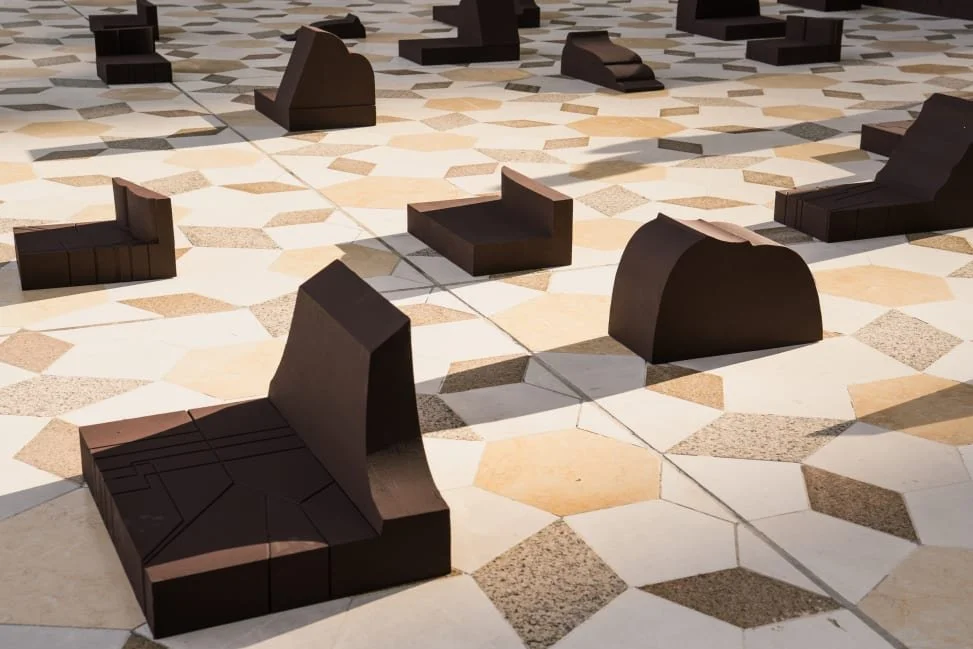
Art Basel / Courtesy the artist
Jenny Holzer’s SONG combined large-scale poetry projections on the Museum of Islamic Art’s façade and inner courtyard with a choreographed drone performance, drawing on texts by Mahmoud Darwish and Nujoom Alghanem. The emotional impact was the subject of most coverage. The more useful observation for interior and architectural designers is technical: drone-deployed projection at that scale requires facade geometry that accommodates reading, darkness management in the surrounding built environment, and clearance above the roofline. This is already entering hospitality briefs in this region, where clients are specifying feature facades that function as projection surfaces after dark. Holzer demonstrated what the ambition looks like at full resolution.
WHAT THIS MEANS FOR RESIDENTIAL ARCHITECTURE IN THE GCC
The first Art Basel edition in the Middle East did not happen in a vacuum. Qatar has been building institutional infrastructure — the Museum of Islamic Art by I. M. Pei, the National Museum of Qatar by Jean Nouvel, the Mathaf Arab Museum of Modern Art — for two decades. What Art Basel Qatar 2026 signals is that the next phase is private: collections moving into homes, foundations, and purpose-built viewing spaces attached to residential compounds.
The spatial implications are specific. The works presented at Art Basel Qatar were not gallery-scaled, and they were not designed to be accommodated within existing domestic proportions. Lynda Benglis’s 37-part glazed ceramic sculpture requires horizontal spread and a floor that can carry distributed load across an irregular form. Large-scale works that investigate surface and material density demand controlled directional lighting at close range, never ambient. These are specifications for a dedicated art room or a reception hall designed around the work, not a living room that happens to have art in it.
For GCC residential design specifically, the timeline between acquisition and delivery is accelerating. Five years ago, a collector might purchase at Art Basel in Basel and spend two years deciding where the work would live. Today, the collector arrives at Art Basel Qatar with a villa under construction in West Bay, a summer residence in Europe already completed, and specific rooms identified for specific acquisitions — in advance. The design team that does not attend events like this cannot make informed structural or spatial recommendations. The one that does arrives at the next project meeting with actual dimensions.
THE DEEPER READING
There is a broader principle embedded in what Art Basel Qatar achieved. By staging the fair across Msheireb Downtown Doha’s urban fabric — not inside a single convention hall — it made the city itself the architecture of display. Works were experienced in movement, between buildings, under open sky, in the spaces between programmed function. This is how serious collectors in this region are beginning to think about their own environments: not as rooms with art on the walls, but as spatial sequences where the art and the architecture are in active conversation.
Art events in this market are not inspiration trips. They are structural and spatial briefings for what clients will commission next. Art Basel Qatar 2026 told anyone paying attention exactly what kind of architecture to prepare for. The question is whether the people designing that architecture were in the room.
